This Blinkit Marketing Strategy Screams “Genius”

Written by Murtaza
Summary
- Blinkit’s “Scream for Ice Cream” campaign turned a standard discount promotion into a viral social media event. Users screamed into the Blinkit app for 15 seconds, with louder screams unlocking larger ice cream discounts.
- The campaign succeeded because it combined entertainment, competition, and real rewards, encouraging users to share their experiences online.
- Using principles from Jonah Berger’s STEPPS framework—Social Currency, Triggers, Emotion, Public visibility, Practical Value, and Stories—Blinkit created content people wanted to talk about.

The Campaign That Made India Scream
Chilla chilla ke sabko ice cream khila do 🍦😋
— Blinkit (@letsblinkit) May 15, 2026
Play Scream for Ice Cream on the Blinkit app and get up to 50% OFF on Ice Creams and Frozen Desserts this weekend! pic.twitter.com/3uk1ybezBy
Picture this: a Tuesday afternoon in May 2026. Across India, people are standing in living rooms, offices, and college hostels — mouths open, throats raw — screaming into their phones. Not because of a cricket match. Not because of a political debate. Because of ice cream.
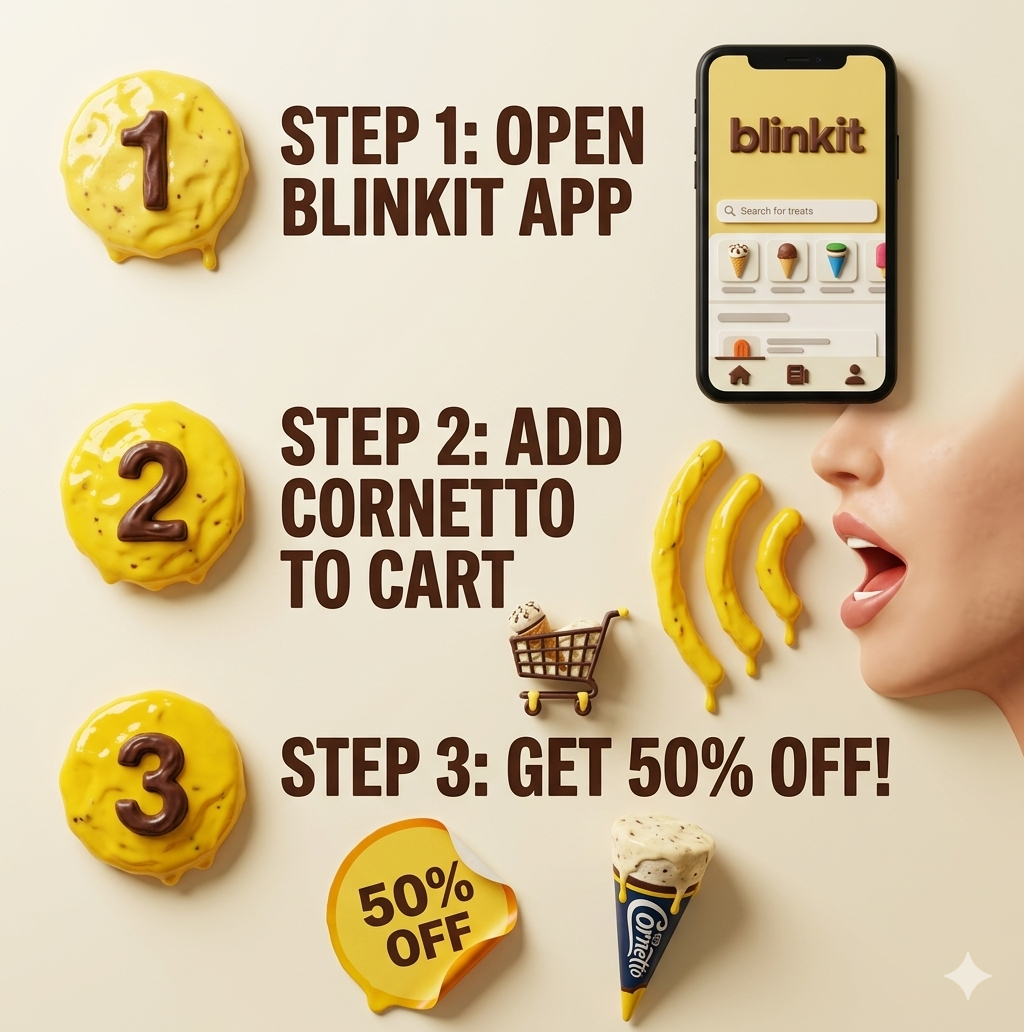
That is the opening scene of one of the most effective social media campaigns in recent Indian quick-commerce history. Blinkit, the ten-minute delivery platform, launched the “Scream for Ice Cream” challenge in collaboration with Kwality Wall’s, Amul, and Havmor. The mechanics were almost offensively simple: open the Blinkit app, tap the challenge banner, and scream into your phone for 15 seconds. The louder you went, the deeper the discount — up to 50% off on selected ice cream brands.
The internet lost its collective mind. And that, precisely, is what makes this marketing strategy worth dissecting.
 Remarkable Facts
Did You Know?
Click the button below to discover a remarkable fact.
Remarkable Facts
Did You Know?
Click the button below to discover a remarkable fact.
How Did the Scream Challenge Actually Work?
Users tapped the challenge banner inside the Blinkit app and screamed into their smartphone microphone for 15 seconds. The app measured real-time sound levels and generated personalised discount coupons — louder meant better deals. The social media campaign covered selected ice cream brands across Amul, Kwality Wall’s, and Havmor, encouraging users to compete with friends and share their scream scores online.
Within days, videos of people attempting the challenge in homes, offices, and hostels began circulating across Instagram Reels, Reddit threads, and WhatsApp groups. The case study write-up practically wrote itself.
What Made It Different From a Standard Coupon?
The average discount code leaves no memory. You apply it, it works, and you forget it ever existed. The Scream for Ice Cream social media campaign forced the user to perform. That performance created a moment worth filming, sharing, and laughing about. The coupon was the excuse. The scream was the story.
Three types of participants the campaign attracted
- The Completionists — screamed genuinely for the deal and shared their win proudly
- The Hackers — blasted audio clips, held the phone near a crying baby, or pointed it at traffic to unlock maximum decibels
- The Spectators — never screamed once, but watched seventeen reaction videos and still told people about it
“Just as people use money to buy products or services, they use social currency to achieve desired positive impressions among their families, friends, and colleagues.”

— Blinkit (@letsblinkit) May 18, 2026
Social Currency: The Real Engine Behind This Social Media Campaign
In Contagious: Why Things Catch On, Jonah Berger identifies Social Currency as the first and most powerful driver of virality. The concept is elegant: we share things that make us look good. Every post, every Reel, every forwarded meme is a micro-performance of identity. The question every marketing strategy must answer is — what does sharing this say about me?
This is not vanity. It is evolutionary wiring. And the Scream for Ice Cream social media campaign was engineered, deliberately or brilliantly intuitively, to generate exactly this kind of currency.
How Did the Scream Campaign Weaponise Social Currency?
The campaign built social currency through four reinforcing mechanisms. The reward made participation rational, but the novelty made it fun. Nobody screams into a grocery app. That absurdity crossed the threshold of ‘this is worth posting’ — sharing the experience signalled that you were the kind of person who does funny, spontaneous things.
The hackers created a second and more powerful wave. When users discovered they could trick the microphone using speakers, crying toddlers, or passing traffic, they shared those tricks as clever discoveries. Sharing a hack makes you look resourceful. That is premium social currency — you are not just a participant, you are an insider.
Competitive framing sealed the deal. The app rewarded the loudest scream with the biggest discount. When performance is measurable and the outcome is public, the urge to prove competence kicks in hard. In a world where professional achievement is difficult to broadcast on Instagram, being the person who unlocked the 50% deal is a small but satisfying trophy worth displaying.
The Tipping Point: When Peer Pressure Took the Wheel
Malcolm Gladwell described the Tipping Point as the threshold moment when an idea crosses from early adopters into the mainstream. For the Scream Challenge, that moment arrived when the first wave of videos made everyone else feel left out. Social proof — the psychological shortcut where we follow the crowd because the crowd’s behaviour implies correct action — took over.
Once enough people were screaming for ice cream on Instagram, not screaming started to feel like missing out. The social media campaign did not buy that second wave. It designed the conditions and stepped back.
The STEPPS framework at work in this case study
- Social Currency — screaming publicly signals you are fun, spontaneous, and in on the joke
- Triggers — summer heat and ice cream cravings were natural, daily reminders built into the season
- Emotion — delight, embarrassment, and laughter — all high-arousal emotions that drive sharing
- Public — scream scores and reaction videos were visible by design, not accidental
- Practical Value — real discounts gave rational cover for an irrational act
- Stories — every participant had a story: the hack, the baby, the coworker who refused
Blinkit's Marketing Strategy: Double Down or Walk Away
Here is the mistake most brands make with viral content: they treat it as a one-time accident. Post one Reel that works. Take a bow. Move on to Q3’s brief. The marketing strategy becomes a trophy instead of a template.
Blinkit took the opposite approach. When a social media campaign format proves it can move audiences, the correct move is to iterate — recreate it, test variations, and ride the wave until the data says otherwise. The platform posted an Instagram challenge: get 5,000 likes and the Scream for Ice Cream campaign comes back.
That post was not just audience research. It was participatory marketing. The audience was given agency over the brand’s next move — and that act of agency itself became a social currency event. You were now part of bringing the campaign back. You had skin in the game.
What Does 'Doubling Down' Actually Mean for a Social Media Marketing Team?
In practical terms it means this: when a Reel format delivers significantly above-average engagement, you do not move on to the next brief. You recreate that format multiple times with small variations — different settings, different participants, different angles on the same core mechanic — and you keep publishing until the engagement drops below baseline. You are not chasing the original viral moment. You are extracting maximum value from a proven format before the algorithm and audience move on.
UGC as a Marketing Strategy Force Multiplier
User-generated content is the most cost-efficient form of social media marketing available to any brand. But it cannot be manufactured. It has to be earned — by giving people an experience that generates a genuine emotion worth broadcasting. Laughter, pride, competitive satisfaction, a hack worth sharing. The Scream Challenge delivered all four simultaneously. Every scream video posted by a user was a free media unit that Blinkit did not produce, plan, or pay distribution fees on.
How to Build a Marketing Strategy That Produces Campaigns Like This

Eight Questions That Force a Brand to Think Like Blinkit
Last day to scream for your ice cream on the Blinkit app🍦📲 pic.twitter.com/DqINjyQx9T
— Blinkit (@letsblinkit) May 24, 2026
Having read Contagious carefully and studied comparable case studies — from the ALS Ice Bucket Challenge to Old Spice’s ‘The Man Your Man Could Smell Like’ to Dove’s Real Beauty — I want to offer something more useful than ‘be creative.’ Campaigns like the Scream Challenge do not emerge from empty brainstorm rooms. They emerge from asking the right questions.
These questions are drawn from Berger’s STEPPS framework, Robert Cialdini’s research on influence and persuasion, and patterns observed across viral social media campaigns over the past decade:
Open All Questions
1 st Question
What exactly was the Blinkit Scream for Ice Cream marketing strategy?
The Scream for Ice Cream was a social media campaign where Blinkit users opened the app, tapped the challenge banner, and screamed into their phone microphone for 15 seconds. The app measured sound levels in real time and generated personalised discount coupons on ice cream brands
5 th Quesion
- How do you give your audience a story to tell at dinner — not just a discount to redeem? 'I screamed into my phone and got 40% off ice cream' is a dinner-table story. 'I used a coupon code' is not. Build narratives, not just transactions.
2 nd Question
- What would make someone want to film themselves doing this and show it to their friends? Filming requires a reason: pride, humour, competitive satisfaction, or a hack worth sharing. Boredom does not make it onto Instagram.
6 th Quesion
- What is the environmental trigger — the daily cue — that will remind people of your campaign without an ad? Summer heat was Blinkit's trigger. Every temperature spike made the ice cream craving spike with it, and the Scream Challenge was right there waiting.
3 rd Question
- Where does your product category intersect with something people already talk about? Ice cream and summer heat is an existing cultural conversation. Blinkit's marketing strategy dropped their campaign into it.
7 th Quesion
- What does sharing this say about the person who shares it? 'I am the kind of person who does funny, spontaneous things for ice cream' is a shareable identity. Match the persona to your audience's self-image.
4 th Question
- What can users compete on — and how do you make the result visible and shareable? The 'louder equals better deal' mechanic was a leaderboard baked directly into the user experience. Competitive framing is criminally underused in social media marketing.
8 th Quesion
- What is the simplest possible entry point for a sceptic? The Scream Challenge required fifteen seconds and an internet connection. No commitment, no sign-up, no fee. Low friction is the unsung hero of every successful social media campaign.
1 st Question
What is the most absurd thing someone could do with your product — and why is that absurdity actually joyful rather than embarrassing? The scream was ridiculous. But it was cathartic ridicule.
2 nd Question
What would make someone want to film themselves doing this and show it to their friends? Filming requires a reason: pride, humour, competitive satisfaction, or a hack worth sharing. Boredom does not make it onto Instagram.
3 rd Question
Where does your product category intersect with something people already talk about? Ice cream and summer heat is an existing cultural conversation. Blinkit's marketing strategy dropped their campaign into it.
4 th Question
What can users compete on — and how do you make the result visible and shareable? The 'louder equals better deal' mechanic was a leaderboard baked directly into the user experience. Competitive framing is criminally underused in social media marketing.
5 th Question
How do you give your audience a story to tell at dinner — not just a discount to redeem? 'I screamed into my phone and got 40% off ice cream' is a dinner-table story. 'I used a coupon code' is not. Build narratives, not just transactions.
6 th Question
What is the environmental trigger — the daily cue — that will remind people of your campaign without an ad? Summer heat was Blinkit's trigger. Every temperature spike made the ice cream craving spike with it, and the Scream Challenge was right there waiting.
7 th Question
What does sharing this say about the person who shares it? 'I am the kind of person who does funny, spontaneous things for ice cream' is a shareable identity. Match the persona to your audience's self-image.
8 th Question
What is the simplest possible entry point for a sceptic? The Scream Challenge required fifteen seconds and an internet connection. No commitment, no sign-up, no fee. Low friction is the unsung hero of every successful social media campaign.
The Marketing Takeaway: Stop Discounting. Start Designing Moments.
That is what separates great social media marketing from the forgettable kind. Not budget. Not celebrity endorsements. Not algorithmic tricks. Just a clear-eyed understanding of what makes human beings want to share — and the nerve to ask them to scream.
Conclusion: A Case Study That Was Always Bigger Than Ice Cream
The Blinkit Scream for Ice Cream case study is not really about ice cream. It is a masterclass in designing for human behaviour. The social media campaign succeeded because it gave people a reason to feel something — and then gave them a frictionless mechanism to broadcast that feeling to the world.
The marketing strategy behind it was anchored in social currency, competitive emotion, low-friction participation, and smart UGC amplification. Jonah Berger mapped the psychology fifteen years ago in Contagious. Blinkit executed it inside a quick-commerce app in 2026, in the middle of an Indian summer, with ice cream and a microphone.
The rest of the marketing industry would do well to study this case closely. And maybe take a deep breath before they scream.
Q1. What exactly was the Blinkit Scream for Ice Cream marketing strategy?
The Scream for Ice Cream was a social media campaign where Blinkit users opened the app, tapped the challenge banner, and screamed into their phone microphone for 15 seconds. The app measured sound levels in real time and generated personalised discount coupons on ice cream brands — the louder the scream, the bigger the discount. The campaign combined a performance-based reward, UGC virality, and competitive social mechanics to drive organic reach at scale across Instagram and Reddit in May 2026.
Q2. What is social currency and how did this social media campaign use it?
Social currency, as defined in Jonah Berger's Contagious, refers to the value people gain in others' eyes from sharing something. The Scream Challenge gave users a ridiculously shareable activity — screaming into a phone for ice cream — that made them look fun, spontaneous, and clever (especially when they shared discount hacks). Sharing the experience was itself a form of self-expression, which is the core mechanic of social currency. The campaign made participating feel more rewarding than the discount alone justified.
Q3. How do I use the STEPPS framework to build a viral social media marketing strategy?
STEPPS stands for Social Currency, Triggers, Emotion, Public, Practical Value, and Stories — the six drivers of word-of-mouth from Berger's Contagious. Apply it by asking: what does sharing this say about the person sharing it (Social Currency)? What environmental cue will remind users of your brand naturally (Triggers)? What high-arousal emotion does the campaign generate (Emotion)? Is participation visible to others (Public)? Is there a tangible benefit (Practical Value)? Does the experience give users a story to retell (Stories)? The Scream Challenge scored on all six.
Q4. Why did Blinkit's marketing strategy work better than a standard discount code?
A standard discount code produces one transaction and leaves no memory. The Scream Challenge produced a transaction, a story, a social post, a reaction video, and a word-of-mouth chain. The coupon was the incentive; the scream was the content. Every participant became an unpaid media channel. That is the core difference between a transactional promotion and a marketing strategy built around social currency and emotional engagement.
Q5. What are the risks of building a social media campaign around UGC and viral mechanics?
Three main risks. First, gaming the system: users quickly found ways to fake loud screams using Bluetooth speakers and audio clips, which erodes the discount economics. Second, virality is not guaranteed — without the right emotional hook, interactive campaigns fall flat and look gimmicky. Third, operational risk: a viral campaign can spike demand faster than supply chains can respond. The Scream Challenge created pressure on last-mile ice cream delivery in peak hours. Viral success without operational readiness is its own kind of problem.
Q6. Is this kind of interactive marketing strategy suitable for every brand?
Not universally, no. The Scream Challenge worked because Blinkit has a young, urban, digitally native audience comfortable with absurdist social content, and ice cream in summer is a near-perfect emotional trigger. A regulatory-heavy sector like banking, pharma, or insurance faces different constraints around tone and compliance. The underlying principle — design campaigns that generate social currency — applies across categories. The specific mechanic needs to be calibrated to your audience's self-image and comfort level with public silliness.
Q7. How did Blinkit use audience feedback to extend the campaign?
After the initial campaign wave, Blinkit posted an Instagram challenge with a simple condition: reach 5,000 likes and the Scream for Ice Cream campaign returns. The post received over 9,000 likes. This was participatory marketing in its most direct form — the audience was given agency over the brand's next decision, which itself became a social currency event. Being part of bringing the campaign back was a shareable story. It closed the social media marketing loop between brand and community with elegance.
Q8. What books and resources should I read to build marketing strategies like this?
Start with Jonah Berger's Contagious (2013) for the STEPPS framework — it is the most empirically grounded book on word-of-mouth marketing available. Add Robert Cialdini's Influence for the psychological levers of persuasion underlying campaigns like this one. For India-specific case studies in quick-commerce and D2C social media marketing, follow Entrackr, Inc42, and the Economic Times Brand Equity section. For academic depth on content virality, Berger's research papers from Wharton's Marketing department are freely available online and worth the time.
Written by Murtaza
Related Articles
Related
The Email Marketing Approach That Actually Gets Results in 2026
Email marketing succeeds through strategy, not sending frequency—segmentation, customer journeys, testing, and measurement consistently outperform mass email blasts. Personalized and behavior-driven emails generate the strongest results—welcome sequences, drip...
Blogging Case Study for Students | blogging strategy examples
Successful blogs are built on strategy, not volume—the highest-performing case studies focused on audits, keyword selection, and content quality rather than publishing more articles. Different growth stages require different blogging strategies—from consistent...
Return of Mascots: the humanization of brand identity | The revival of brand mascots
1. Brand Mascots Outperform Celebrities Mascots generate stronger brand recall, lower long-term costs, and greater ownership than celebrity endorsements. They become long-term brand assets that build recognition and trust over time. 2. In the AI Era, Personality Is a...