Written by Murtaza
Summary
1. Brand Mascots Outperform Celebrities
Mascots generate stronger brand recall, lower long-term costs, and greater ownership than celebrity endorsements. They become long-term brand assets that build recognition and trust over time.
2. In the AI Era, Personality Is a Competitive Advantage
As AI-generated content and marketing become increasingly similar, distinctive mascots help brands feel more human, memorable, and emotionally engaging. This is why major tech companies are increasingly investing in mascot-driven branding.
3. A Great Mascot Is Built on Character, Not Design
Successful mascots begin with a clear personality, role, voice, and flaw before visual design. Their value comes from consistently expressing the brand’s identity and giving companies a unique, relatable voice.

Introduction: The Best Employee at Most Companies Doesn’t Draw a Salary
A cartoon owl has guilt-tripped 20 million people into doing their language homework. A retired paperclip came back from the dead as a cult hero. Meanwhile, a famous face charges a fortune to hold your product for nine seconds, then forgets your brand by lunch.
Welcome to the strange, wonderful economics of brand mascots — where the cheapest hire on the payroll quietly outperforms the most expensive one.
Here is the thing nobody says out loud in marketing meetings. The most creative person in any company is usually hiding in the crowd. The intern. The social media manager. The quiet designer who doodles in the margins. Hand them a celebrity to babysit and they shrink. Hand them a character to build, and they go gloriously feral.
That is what brand mascots really are. Not a logo with arms. A permission slip to be brave. This guide is about why those weird little guys win — backed by hard numbers, a parade of famous mascots, and one chai-shop philosopher I once invented at 2 a.m.
 Remarkable Facts
Did You Know?
Click the button below to discover a remarkable fact.
Remarkable Facts
Did You Know?
Click the button below to discover a remarkable fact.
What Brand Mascots Actually Are (And Why They Beat a Logo)
Before we crown the winner, let us define the contestant. Plenty of marketers use the word loosely, and that vagueness is exactly why so many mascots flop.
What is a brand mascot in simple terms?
A brand mascot is a character — drawn, animated, or stuffed into a costume — that becomes the face, voice, and personality of a company. It does what a logo cannot: it talks, jokes, sulks, and shows up in your feed like a friend who happens to sell something.
A logo is a signature. A mascot is a soul. One tells you who signed the cheque; the other makes you want to split a beer with the brand. That difference — flat identity versus living brand personality — is the whole game.
How a mascot actually rewires your brain
Humans are hopeless for faces. We see them in clouds, plug sockets, and burnt toast. We also evolved to melt at big eyes and big heads, the way we do for babies — which is precisely why so many mascots are designed that way, as explained in this look at why big tech is humanising AI with mascots.
The data backs the biology. On the Distinctive Asset scale, characters score 105 for brand linkage — crushing logos at 82, colours at 38, and fonts at a sad little 31. Put simply, people remember a face long after they have forgotten your typeface, a point System1’s analysis of memorable characters in advertising makes in detail.
The main types of company mascots
Not all mascots do the same job. Most of the popular brand mascots fall into a handful of archetypes:
• The Helper — guides you through something dull. Duolingo’s owl, Clippy the paperclip.
• The Hero — embodies the product’s best self. The Michelin Man, Tony the Tiger.
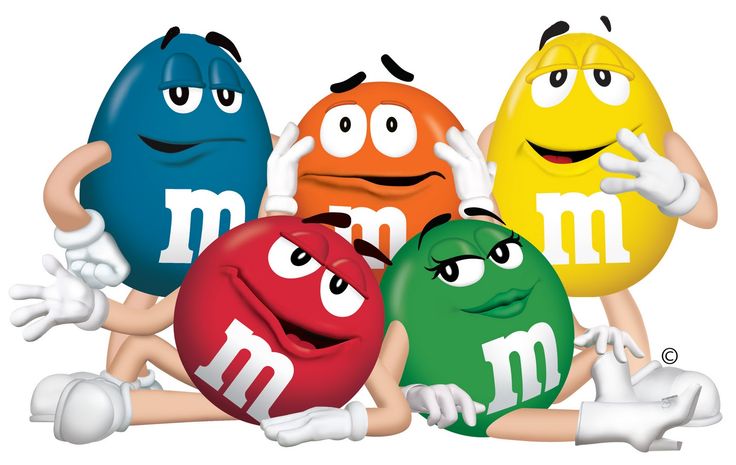
• The Troublemaker — gets away with cheek the brand never could. The M&M’s spokescandies.
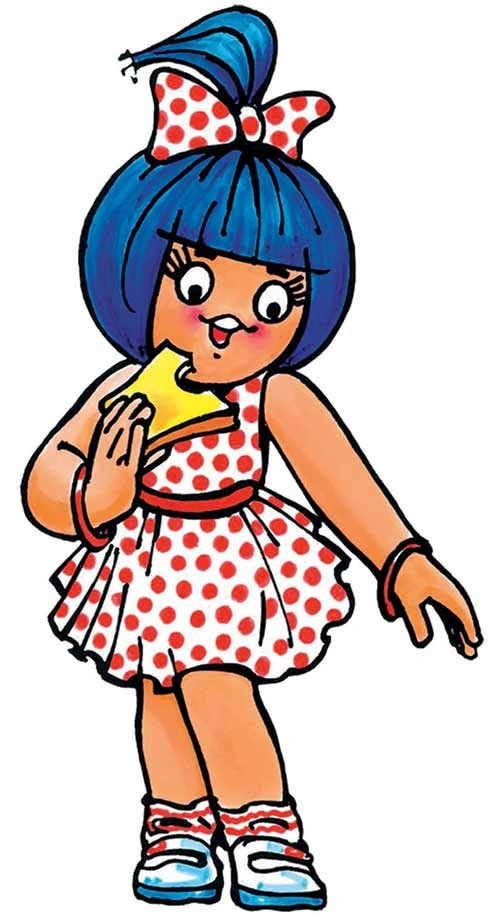
• The Everyman — looks like your funny uncle. The Amul Girl, who comments on the news like a tiny pundit.
• The Creature — pure charm, no logic required. The Coca-Cola polar bear, Mailchimp’s Freddie.
“The next generation of mascots won’t just entertain, they’ll evolve. Expect characters that shift tone based on your shopping habits and deliver messages in the right tone, right language, right time zone.” [1]
The Numbers: Mascots vs Celebrities (It Is Not Close)
If you suspect this is sentimental nonsense from people who like cartoons, good. Scepticism is healthy. Now meet the receipts.
Across four years of Super Bowl ads, brand characters averaged 3.8 stars for effectiveness while celebrity-led spots managed just 2.7, with mascot-fronted Super Bowl ads also winning on short-term sales. Ipsos found ads with brand characters deliver up to 6x better recall than ads without — and more than double the attention of a celebrity, as reported when brand characters outperformed celebrity endorsers across the board.
Long-term, the gap widens. Drawing on the IPA Databank, research compiled by Adweek on whether mascots move the needle found campaigns with a mascot are 37% more likely to grow market share, win 27% more new customers, and lift profit by around 30%.
And the punchline? Only about 4% of top US brands actually use a mascot. That is not a saturated market. That is a wide-open field with a velvet rope and nobody guarding it.
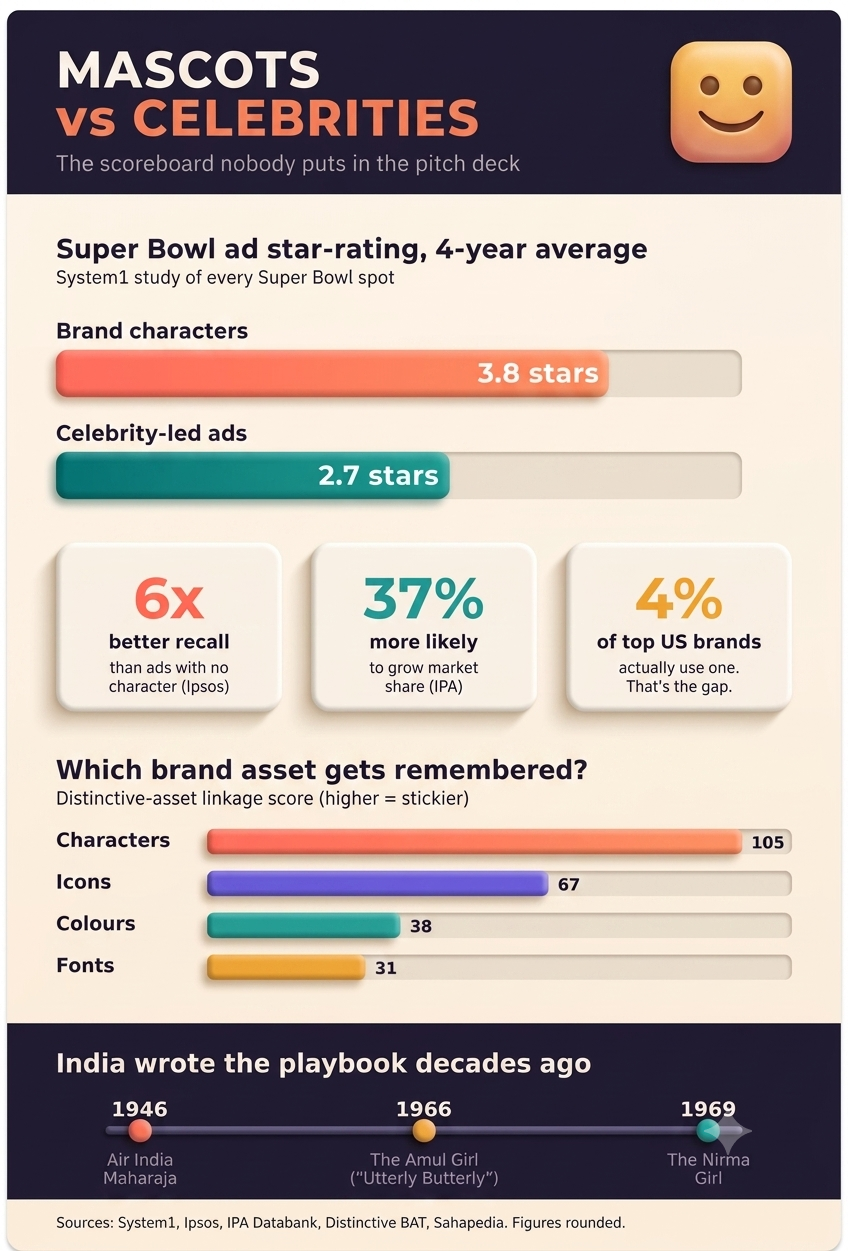
Read the table above as a boxing card. The celebrity wins the entrance music. The mascot wins the fight, every round that matters.
|
The round |
Brand mascot |
Celebrity ambassador |
|
Upfront cost |
Design + animation, one time |
Six- to seven-figure fees, often |
|
Cost over time |
Falls every year you reuse it |
Rises every renewal |
|
Brand recall |
Up to 6x stronger |
Baseline, often diluted |
|
Scandal risk |
Near zero — it can’t tweet drunk |
Always one headline away |
|
Who owns it |
You do, forever |
They do, until the contract ends |
|
Shelf life |
Decades (see: the Amul Girl) |
One campaign cycle, usually |
India Wrote This Playbook Before Silicon Valley Was Born
Here is a fact the global marketing press keeps rediscovering with great surprise: India has been running the most charming mascots on earth for the better part of a century.
The Air India Maharaja arrived in 1946 — before the country was even a republic — dreamed up by commercial director Bobby Kooka and JWT artist Umesh Rao, reportedly born on an in-flight memo pad. He was royalty with a wink, and you can read the story of Air India’s Maharaja for the full mischief.
Then came the queen of them all. In 1966, Sylvester da Cunha and illustrator Eustace Fernandes gave the country the Amul Girl — blue hair, polka-dot frock, and a tongue sharper than most newspaper columnists. Six decades later she still roasts politicians and cricket scores weekly, which is why the Amul Girl’s six-decade run is one of the longest campaigns in advertising history.
She had company. Nirma’s spinning girl (1969), R. K. Laxman’s Gattu for Asian Paints, and later Vodafone’s ZooZoos all became household names. For a fuller gallery, Sahapedia’s archive of India’s iconic advertising mascots is a delight — and a reminder that while the West rediscovers the iconic mascot, India never forgot it.
The Class of 2026: When Big Tech Started Making Weird Little Guys
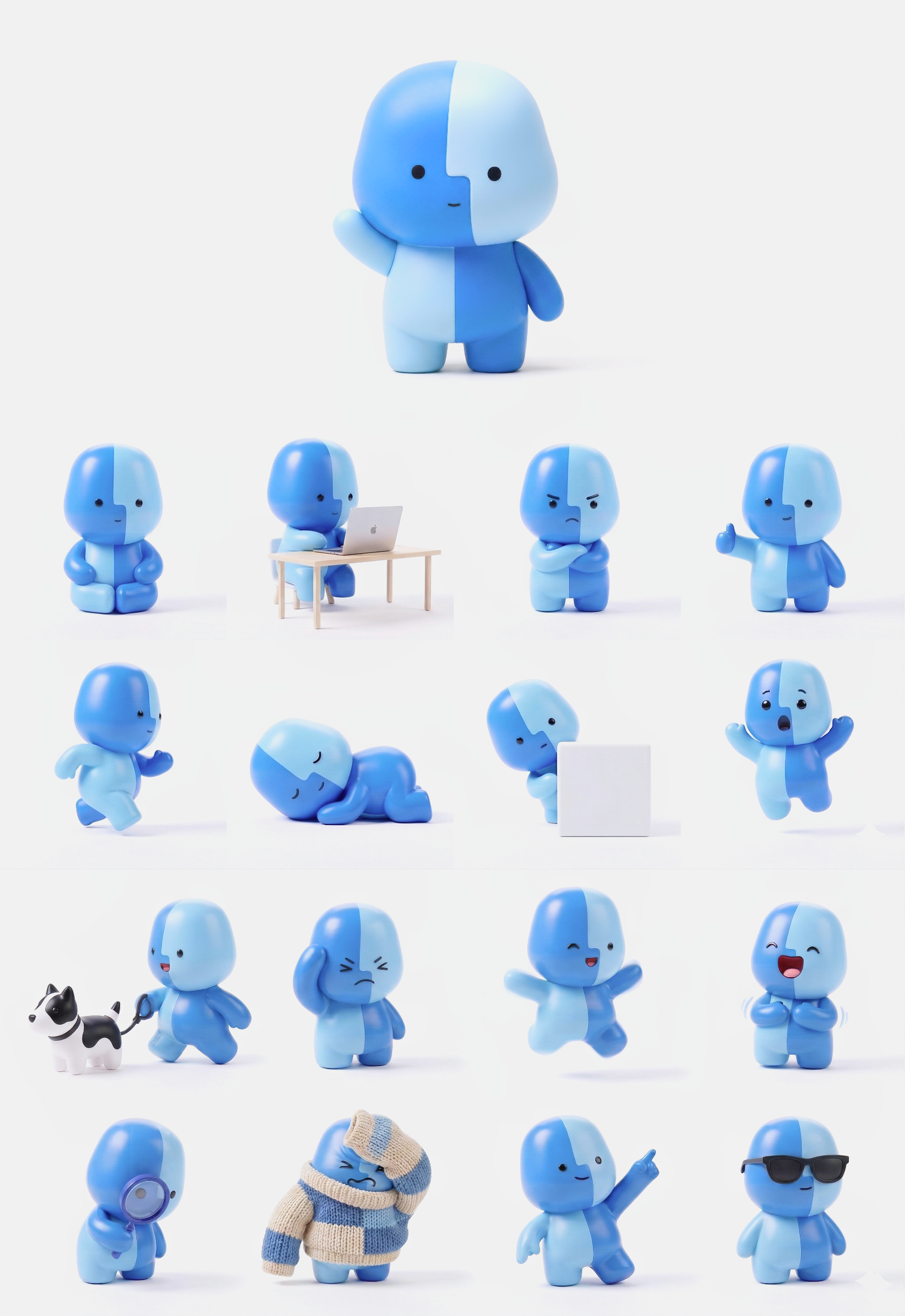
Something strange happened on the way to the AI revolution. The most data-driven companies on the planet decided what they really needed was a cartoon friend.
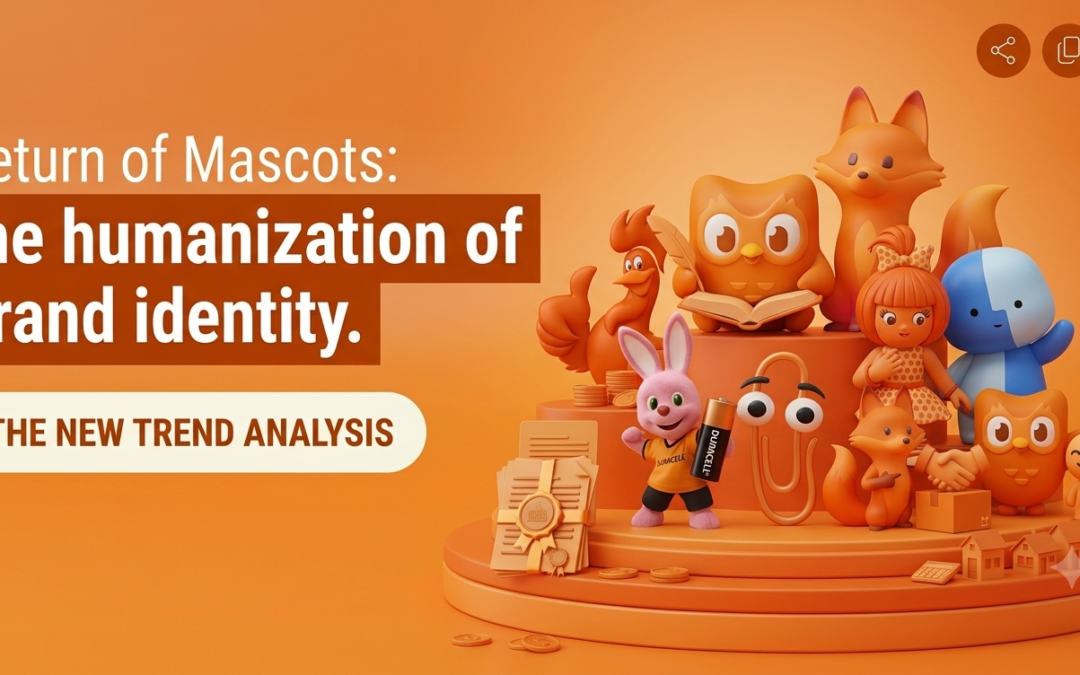
Duolingo led the charge, turning its owl, Duo, from a polite reminder into a chaotic internet gremlin with more than 20 million followers. Google made Android’s Bugdroid customisable. Then the floodgates opened. Microsoft, which once fired Clippy in disgrace, unveiled Mico — a warm little blob for Copilot — and quietly hid Clippy inside as an Easter egg, the soft-launch redemption arc nobody asked for but everybody loved.
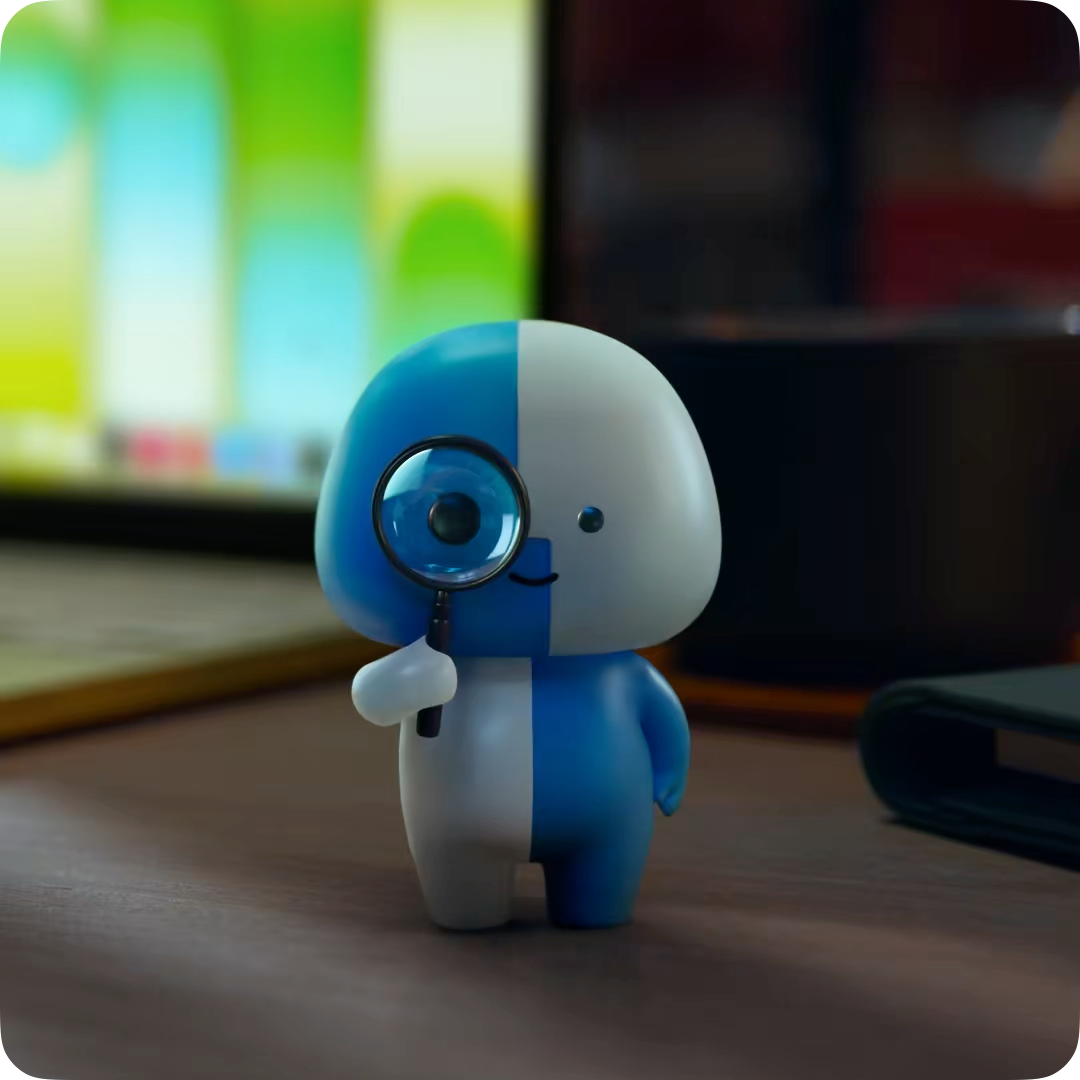
Mozilla introduced Kit, a new non-binary Firefox mascot. Apple slipped an unofficial blue-and-white figure, nicknamed Lil’ Finder Guy, into its social videos. Reddit gave Snoo a glow-up. The 2026 class is a full roll call — Kit, Ebb, Alan, the Coca-Cola polar bear, Duo, Bugdroid, Freddie, Vivienne, Hutty, Cornelius, Mico, Clippy, and Lil’ Finder Guy — proof that the costume rack has never been busier.
Why now? Because AI made everything sound identical. Every ad, every caption, every chatbot has the same polite, frictionless hum. A mascot is the antidote to that sameness — a weird, specific, human-feeling thing in a sea of beige. As industry writers note, mascots are reappearing across categories precisely because audiences are starving for personality.
How to Build a Brand Mascot That Does Not Embarrass You
Most mascots fail for the same reason most karaoke fails: someone skipped the personality and went straight for the costume. Do it the other way round.
How do I create a brand mascot for my business?
Start with a personality, not a drawing — decide who the character is before you decide what it looks like. Then follow a simple sequence:
- Write the personality first. Backstory, voice, values, sense of humour. The pixels come last.
- Give them a flaw. Perfect mascots are boring. Duo is unhinged. Clippy was annoying. Flaws make characters human.
- Give them a job. Helper, hero, troublemaker — pick one. A mascot with no role is a mascot with no reason.
- Commit for years. Consistency is the compounding interest of branding. One quarter is not a mascot; it is a costume rental.
- Hand the keys to the hidden creative. The person itching to be funny will do more for your brand than any agency retainer.
Let me prove the last point with a confession. I once built a ghost project — a full social media marketing strategy for Chai Point — and the whole thing lived or died on one invented mascot: Annaya Rao.
Annaya was a divorced, deeply intelligent chai-shop philosopher. Wise about people, gentle about their nonsense, and — like Michael Scott — unintentionally funny precisely because he never meant to be. He could say things the brand never could in a corporate voice: tender things, ridiculous things, true things about heartbreak over a cutting chai.
The strategy was not really about tea. It was about giving a character permission to be a person. That is the secret the data keeps screaming: a mascot is not decoration. It is the safest place a brand will ever store its courage.
A mascot is powerful, which means a bad one is powerfully bad. Walk in with open eyes.
The first risk is the cringe gap — a character that thinks it is funnier than it is. The second is inconsistency, where the mascot’s voice lurches monthly because nobody wrote it down. The third is the swap-out: when M&M’s briefly replaced its spokescandies with a celebrity, the ad scored a flat 1.0; when the candies returned, it soared to 4.8. The audience told them, loudly, who they came to see.
There is also fatigue. With every brand now launching a quirky character, sameness can creep back in a new costume — so a mascot still has to earn its weirdness, not just wear it. And settle the boring legal bit early: own the design and the rights outright, or your beloved character becomes someone else’s asset.
Conclusion: Hire the Weird Little Guy
Strip away the cartoons and the puns and you are left with a simple ledger. Mascots beat celebrities on recall, on cost over time, on scandal risk, and on the one thing money cannot rent — ownership. A brand with a mascot owns its fame outright; the celebrity forgets your brand by lunch, while the mascot is yours for decades.
And the best part costs nothing extra. The person who can build that character is probably already on your team, hiding in the crowd, waiting for someone to hand them permission instead of a brief. Give the weird little guy a chance. Hire the mascot. Then let the quietest creative in the room go feral.
Frequently Asked Questions
What is a brand mascot in plain English?
A brand mascot is a character that acts as the personality of a company — a drawn, animated, or costumed figure that talks and behaves like a person. Unlike a logo, it can joke, react, and build a relationship with your audience. Think Duolingo's owl or the Amul Girl. It turns a faceless business into something people actually feel about.
What is the difference between a brand mascot and a brand ambassador?
A brand ambassador is a real, hired human — usually a celebrity — who represents you for the length of a contract. A brand mascot is a fictional character you own outright and forever. The ambassador rents you their fame; the mascot builds fame that belongs to you. One can quit or cause a scandal; the other cannot.
How do I create a company mascot on a small budget?
Begin with personality, not illustration — write the character's voice, backstory, and flaws first. A talented freelance illustrator can then bring it to life affordably, which is why even small business mascots can punch far above their budget. Keep the design simple enough to redraw in many poses. Our internal guide on building a brand personality from scratch walks through this, and you can also study how big tech is humanising AI with simple, cheap mascots for inspiration.
How much does a brand mascot cost?
It ranges widely. A simple freelance-designed mascot can cost a few hundred to a few thousand dollars; a fully animated, agency-built character runs much higher. The real saving is over time — unlike a celebrity whose fee rises each renewal, a mascot you own gets cheaper to use with every campaign. It is one of the rare marketing assets that appreciates.
What are the risks of using brand mascots?
The main risks are tone-deaf humour, inconsistent voice, and abandoning the mascot too early to build any equity. There is also growing mascot fatigue as every brand launches a quirky character. Finally, sort out ownership and IP rights upfront. Done carelessly, a mascot can feel forced; done well, it is one of the safest bets in marketing.
Are mascots still effective in 2026, or is it just a trend?
They are more effective than ever, which is exactly why the trend exists. As AI flattens everything into the same polished sameness, a distinctive character stands out by being human and specific. The effectiveness data has held for years across the IPA Databank and System1 testing. This is not a fad chasing results; it is brands finally catching up to results that were always there.
Do mascots actually increase sales and brand recall?
Yes, and measurably. Ipsos found brand characters can lift recall up to 6x, and IPA data links mascot campaigns to 37% higher odds of market-share growth and roughly 30% more profit. The evidence is strongest when the character is used consistently for years, as System1's work on memorable advertising characters shows. A mascot used once is a cost; a mascot used for a decade is an asset.
Where do I start if I want a mascot for my brand?
Start by writing one paragraph describing your mascot as if it were a person at a party — its job, its flaw, its sense of humour. If that paragraph makes you smile, you have something worth drawing. From there, brief an illustrator, lock the personality in a one-page style guide, and commit to using it everywhere for at least a year. The hardest part is not the design. It is the courage to be specific.
Written by Murtaza
Related Articles
Related
The Email Marketing Approach That Actually Gets Results in 2026
Email marketing succeeds through strategy, not sending frequency—segmentation, customer journeys, testing, and measurement consistently outperform mass email blasts. Personalized and behavior-driven emails generate the strongest results—welcome sequences, drip...
Blogging Case Study for Students | blogging strategy examples
Successful blogs are built on strategy, not volume—the highest-performing case studies focused on audits, keyword selection, and content quality rather than publishing more articles. Different growth stages require different blogging strategies—from consistent...
This Blinkit Marketing Strategy Screams “Genius”
Blinkit’s “Scream for Ice Cream” campaign turned a standard discount promotion into a viral social media event. Users screamed into the Blinkit app for 15 seconds, with louder screams unlocking larger ice cream discounts. The campaign succeeded because it combined...